



Agro-forestry, permaAgroforestry, permaculture and other farming methods exist to address the climate and ecological challenges of our time. In this section, we will discuss all the technical aspects of these different sustainable farming methods.
The intensive agriculture developed in the 20th century, based on the massive use of chemical inputs and maximum soil productivity, has contributed to environmental degradation and has proven effects on human health. Faced with these limitations, more sustainable forms of agriculture are now emerging, which respect ecosystems and populations.
Among these, agroecology offers ecological management of natural resources, incorporating practices such as composting, intercropping, reduced tillage and water and soil conservation.
Permaculture, meanwhile, goes beyond agricultural production alone: it is based on a global design of living systems, where each element is designed to interact harmoniously with the others, with a view to efficiency and sustainability.
Agroforestry combines crops, trees and sometimes animals on the same plot of land. These mixed systems improve biodiversity, enrich the soil and protect crops, while diversifying sources of production.
Find out more…
Biodiversity refers to the variety of life on Earth at several levels:
The diversity of species, such as tomatoes, which have several thousand varieties.
Genetic diversity within a single species (shape, colour, size).
The diversity of ecosystems, such as forests, oceans and deserts.
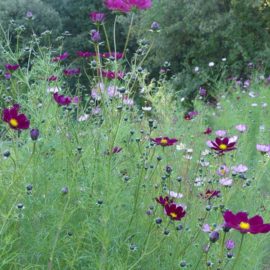
Biodiversity is valuable in the garden: insects, birds and small animals control pests, pollinate crops and enrich the soil. Encouraging their presence (shelters, hedges, varied flowers) helps to create a healthier and more resilient vegetable garden.
Useful and vibrant plants
Fragrant, aromatic and medicinal plants, already present in medieval gardens in the 7th century, are valuable for cooking, health and biodiversity.
Fragrant plants (lavender, chamomile, rose geranium) are used in perfumery, cosmetics and cooking.
Aromatics (mint, thyme, oregano, rosemary, etc.) enhance dishes and can also be consumed as herbal teas.
Medicinal plants (nettle, marigold, marshmallow, echinacea, etc.) have properties depending on the parts used.
Some easy-to-grow plants include nasturtium, lemon balm, mint, marigold, thyme, lavender, sage, nettle and marigold.
They beautify the garden while feeding pollinators and promoting biodiversity.
Find out more…
Also known as companion planting, this technique involves combining complementary plants that do not have the same needs or growth patterns. For example, carrots grow deep into the soil while tomatoes grow tall, so they use space differently without getting in each other’s way.
Some plants can also repel pests. Marigolds, for example, repel whiteflies with their scent: planting them near susceptible vegetables can provide natural protection for the vegetable garden.
Combining short-cycle plants (lettuce, radishes) with long-cycle plants (cabbage, carrots) also helps to optimise growing space.
An ancient example of companion planting is Milpa, practised in Central America, where corn, climbing beans and squash are grown together.
Examples of companion planting
– Raised beds cultivation
In nature, plants grow at different levels: trees, shrubs, grasses, etc. We can draw inspiration from this for our gardens, especially when space is limited, by growing plants at height using structures such as trellises, stakes or even fences.
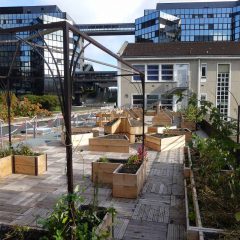
Examples of raised beds cultivation
– Raised bed cultivation (or lasagne gardening)
In a forest, plants grow without human intervention because the soil is naturally rich and fertile: this is humus, formed by the decomposition of organic matter (leaves, wood, etc.) thanks to the action of worms, bacteria and fungi.
It is possible to replicate this process in the vegetable garden by creating a fertile mound. Different layers (lasagne) are alternated, alternating between nitrogenous and carbonaceous materials.
Find out more about raised beds cultivation.
In an agroecological and permaculture approach, water is a precious resource that must be managed carefully. We favour systems that slow down, capture and infiltrate water as soon as it falls. Drip irrigation and mulching also reduce water consumption.
Examples from Transjardins projects
Fertile soil is rich in micronutrients, which are a source of nourishment for plants and are produced by the decomposition of organic matter. Poor soil must be enriched before it can be used for cultivation. In this section, discover techniques for composting and fertilisation, planting fertiliser trees on crop beds, using biochar, and implementing green manure.
Learn more about soil fertilization.
Combining livestock farming and food crops is a technique commonly used in agroecology and agroforestry. Trees can protect animals from the sun and provide fodder, while animals can eat fruit worms and prevent them from spreading, weed the soil and provide useful compost for the garden.
Examples from Transgardens projects
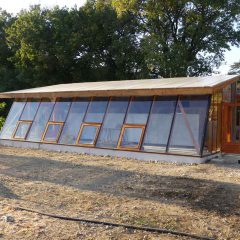
Certain structures can be set up in a garden to optimise certain garden functions. This section presents a few agricultural modules that have been set up in various Transjardins educational gardens, along with their uses.
Examples from Transgardens projects